

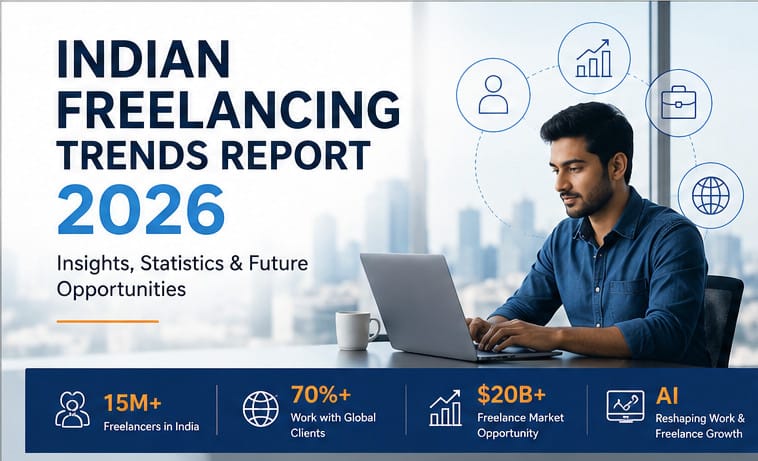
Indian Freelancing Trends Report – India’s freelancing sector keeps changing while companies are adopting flexible hiring, remote teamwork, and workflows augmented by the use of AI technology. Freelancing isn’t limited anymore to graphic designing and copywriting. Nowadays, freelancers are engaged in work related to, for example, software development, cybersecurity, AI implementation, finance, legal advising, and customer service.
There are a number of factors contributing to such tendencies. Startups need experienced employees without the need to hire new permanent workers. Smaller companies opt for cheap highly-skilled specialists. More often, companies outside of India hire qualified experts from the country due to the availability of talents and technical skills possessed by Indians.
Artificial intelligence is also changing how freelancers work. Instead of replacing professionals outright, AI is becoming part of the daily workflow for many tasks, including research, coding assistance, content drafting, design ideation, automation, and data analysis. This has increased demand for freelancers who can combine domain expertise with AI tools while delivering original, high-quality work.
This report examines the latest publicly available industry data, labour market trends, AI adoption patterns, and hiring behaviour affecting freelancers in India during 2026. Rather than presenting statistics alone, each major trend is explained in practical terms to help freelancers, businesses, and hiring managers understand what is changing and how they can respond.
Whether you are planning a freelance career, expanding an agency, hiring independent professionals, or tracking India’s digital workforce, this report provides a research-backed overview of one of the country’s fastest-changing employment segments.
Main Points
- India’s freelance economy continues to benefit from remote work adoption and global digital hiring.
- AI is increasing demand for professionals who combine technical expertise with problem-solving skills instead of relying on repetitive work alone.
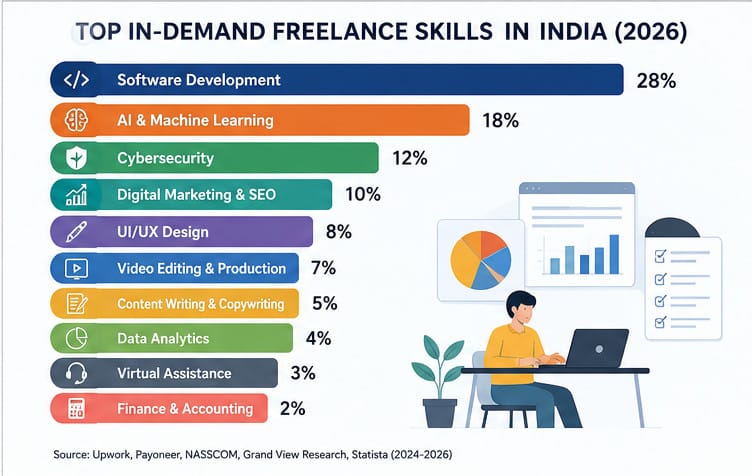
- Software development, AI services, cybersecurity, digital marketing, video production, and data analytics remain among the strongest freelance categories.
- Businesses increasingly prefer project-based hiring to reduce costs and access specialized expertise.
- Portfolio quality, niche specialization, communication skills, and client trust have become stronger income drivers than years of experience alone.
- Freelancers who continuously update their skills are better positioned to compete in both domestic and international markets.
Table of Contents
Indian Freelancing at a Glance (2026)
The following table highlights some of the most important trends shaping India’s freelance market. Detailed analysis appears later in this report.
| Area | Trend | Why It Matters |
| Remote Hiring | Continues to grow across industries | Businesses have access to wider talent pools |
| AI Adoption | Increasing across freelance workflows | AI skills are becoming valuable across multiple professions |
| Global Clients | More Indian freelancers serve international businesses | Higher earning opportunities for experienced professionals |
| Specialized Skills | Demand continues shifting toward niche expertise | Specialists often command higher rates than generalists |
| Flexible Hiring | Project-based work remains attractive for employers | Companies reduce fixed hiring costs while accessing expertise |

What Is Driving India’s Freelance Economy in 2026?
India’s freelance market is growing because several long-term trends are moving in the same direction. Remote work, digital business expansion, AI adoption, and global talent marketplaces have changed how companies build teams. Instead of hiring every specialist full-time, many organizations now assemble project-based teams that include independent professionals.
The result is a labour market where skills often matter more than location.
Below are the biggest forces influencing India’s freelance economy in 2026.
1. Businesses Are Prioritizing Skills Over Traditional Hiring
Many organizations no longer require every role to be filled by a permanent employee. Instead, they hire specialists when a project requires specific expertise.
Examples include:
- AI implementation
- Website development
- SEO consulting
- Mobile app development
- Brand design
- Financial consulting
- Technical writing
This approach helps businesses reduce long-term hiring costs while accessing experienced professionals only when needed.
What this means
Freelancers with clearly defined expertise often compete against other specialists rather than general job applicants.
Why it matters
Professionals who position themselves around one niche frequently build stronger client trust than those offering dozens of unrelated services.
2. Remote Work Has Become Normal for Many Industries
Remote collaboration is no longer viewed as a temporary solution. Businesses have invested in cloud platforms, digital communication tools, project management software, and secure online payment systems that make distributed teams easier to manage.
For freelancers, this expands the available client base beyond their local city.
A developer in Indore can work with a startup in Bengaluru, a marketing consultant in Jaipur can support a company in Singapore, and a designer in Kochi can collaborate with agencies in Europe without relocating.
What this means
Location has become less important for many knowledge-based services.
Why it matters
Freelancers who communicate professionally and deliver consistent results can access opportunities that were previously limited by geography.
3. Artificial Intelligence Is Changing Work, Not Eliminating It
AI has become part of many freelance workflows, but its impact differs across professions.
Routine tasks such as basic content drafting, repetitive coding assistance, simple image generation, transcription, and data organization are becoming faster through AI-assisted tools.
At the same time, businesses continue to value human expertise for work that requires judgment, creativity, strategic thinking, industry knowledge, and client communication.
What this means
Clients increasingly expect freelancers to use AI where it improves efficiency while maintaining accuracy and originality.
Why it matters
Professionals who combine AI tools with strong subject knowledge are often better positioned than those who rely entirely on manual processes or entirely on automation.
4. India’s Digital Economy Continues to Create New Opportunities
The expansion of digital businesses has increased demand for professionals across multiple industries.
Growing demand is visible in areas such as:
- E-commerce
- SaaS
- FinTech
- EdTech
- HealthTech
- Artificial Intelligence
- Digital Marketing
- Cloud Computing
- Data Analytics
Each growing industry creates demand for developers, marketers, designers, consultants, writers, analysts, customer success professionals, and other specialists.
What this means
Freelance opportunities are no longer concentrated in only a few traditional categories.
Why it matters
Professionals who understand industry-specific problems often find more consistent work than those competing only on price.
5. International Hiring Continues to Expand
Many overseas businesses hire Indian freelancers because of the country’s large English-speaking workforce, technical capabilities, and experience with remote collaboration.
Cross-border hiring also allows companies to access specialized talent without establishing local offices.
What this means
Freelancers increasingly compete in a global marketplace rather than only within India.
Why it matters
Success depends not only on technical skills but also on communication, reliability, documentation, and long-term client relationships.
Market Overview
India has developed one of the world’s largest pools of digital talent. This growth has been supported by improvements in internet connectivity, online education, cloud-based collaboration tools, digital payment infrastructure, and broader acceptance of remote work across industries.
Freelancing has also become more diverse. While software development and design remain major categories, businesses now hire independent professionals for accounting, HR consulting, cybersecurity, legal documentation, AI integration, research, video editing, business operations, and many other specialized functions.
One noticeable change is that businesses are placing greater emphasis on measurable outcomes instead of hourly availability. Clients increasingly look for freelancers who can solve business problems, communicate effectively, and deliver consistent results.
This trend benefits professionals who invest in building expertise, maintaining strong portfolios, collecting client testimonials, and developing long-term relationships instead of competing solely on lower pricing.
For businesses, freelancing offers flexibility and access to specialized skills. For professionals, it creates opportunities to work across industries, build multiple income streams, and collaborate with clients from different regions. As digital transformation continues, freelance work is becoming an established part of the broader employment ecosystem rather than an alternative to traditional careers.
Indian Freelancing Statistics, AI Trends & High-Growth Skills
Numbers alone don’t explain where the market is heading. The real value comes from understanding why those numbers are changing and what freelancers and businesses should do next.
The statistics below are based on publicly available industry reports, platform insights, and market research available at the time of writing.
Statistic 1: India Remains One of the World’s Largest Freelance Talent Markets
India continues to rank among the world’s largest sources of freelance professionals. Its talent pool spans software development, digital marketing, design, finance, consulting, customer support, AI services, and many other knowledge-based professions.
What this means
India is no longer competing only on affordability.
Businesses are increasingly hiring Indian freelancers because they can find experienced specialists across almost every digital service category.
Why it matters
A larger talent pool creates more competition.
Generalists may find it harder to stand out, while specialists with clear expertise can position themselves more effectively.
Freelancer takeaway
Instead of marketing yourself as:
“Digital Marketing Expert”
consider positioning around a niche such as:
- SaaS SEO
- Healthcare Content Marketing
- AI Automation Consulting
- Shopify Development
- B2B Lead Generation
Specialization often improves visibility and pricing power.
Statistic 2: Remote Hiring Continues to Expand
Companies across startups, SMEs, and enterprise organizations continue hiring remote professionals for project-based work instead of building large permanent teams. Remote collaboration has become a standard operating model for many digital businesses.
What this means
Freelancers are no longer limited by geography.
Clients increasingly compare skills, portfolios, communication, and reliability rather than physical location.
Why it matters
Professionals living outside major technology hubs can now compete for the same opportunities as freelancers in metropolitan cities.
Freelancer takeaway
Invest in:
- Professional portfolio
- Strong client communication
- Clear service packages
- Reliable project delivery
These factors often influence hiring decisions more than location.
Statistic 3: AI Adoption Is Accelerating Across Freelance Work
Artificial intelligence has become part of everyday workflows for many freelancers.
Instead of replacing professionals entirely, AI is helping automate repetitive tasks such as research, drafting, coding assistance, image generation, documentation, and workflow automation. Skilled professionals increasingly use AI to improve productivity while adding human expertise where judgment and creativity matter most.
What this means
Clients expect faster delivery without sacrificing quality.
Simply using AI tools is no longer a competitive advantage.
Knowing how to combine AI with professional expertise is becoming the differentiator.
Why it matters
Businesses still pay for outcomes.
AI can generate information.
Professionals create solutions.
Freelancer takeaway
Learn AI tools relevant to your field, but continue improving:
- Strategic thinking
- Communication
- Problem solving
- Domain expertise
- Quality assurance
Those skills remain difficult to automate.
Statistic 4: The Freelance Platform Industry Is Growing Rapidly
The global freelance platform market is projected to expand significantly during the coming years, supported by increased remote hiring, AI-powered talent matching, and growing acceptance of flexible work arrangements. Asia-Pacific is expected to be one of the fastest-growing regions.
What this means
Businesses are becoming more comfortable hiring independent professionals online.
This creates opportunities for skilled freelancers across multiple industries.
Why it matters
Competition will increase alongside demand. – Clients will have more choices.
Freelancers with stronger portfolios, verified experience, and professional profiles will likely benefit.
Freelancer takeaway – Treat your profile like a business website.
Keep it updated with:
- Recent projects
- Client testimonials
- Certifications
- Portfolio samples
- Case studies
How AI Is Reshaping Freelancing
AI is changing freelance work in three different ways.
Some tasks are becoming faster.
Some services are evolving.
Entirely new opportunities are emerging.
The biggest winners are professionals who understand where AI fits into their workflow instead of viewing it only as competition.
| Traditional Workflow | AI-Assisted Workflow |
| Manual research | AI-assisted research with human verification |
| Basic content drafting | AI draft + expert editing |
| Manual coding support | AI-assisted development + testing |
| Basic image creation | AI concepts + professional refinement |
| Repetitive reporting | Automated reporting with human insights |
The pattern is consistent across industries.
Routine work is becoming faster. – High-value thinking is becoming more valuable.
Skills That Benefit Most From AI
AI works best as an assistant in areas such as:
- Content strategy
- Programming
- Data analysis
- Digital marketing
- SEO
- Customer support automation
- Video editing
- Graphic design ideation
- Business research
- Process automation
Clients increasingly look for professionals who can deliver better results—not simply produce more content.
Highest-Paying Freelance Skills in 2026
Income depends on specialization, experience, client quality, and project complexity.
The following categories continue attracting strong demand across freelance marketplaces.
| Skill | Market Demand | Competition | Long-Term Outlook |
| AI Development & Automation | Very High | Medium | Excellent |
| Software Development | Very High | High | Excellent |
| Cybersecurity | High | Medium | Excellent |
| Cloud Engineering | High | Medium | Excellent |
| Data Analytics | High | Medium | Strong |
| SEO Strategy | High | High | Strong |
| Performance Marketing | High | High | Strong |
| UI/UX Design | High | Medium | Strong |
| Video Production | High | Medium | Strong |
| Technical Writing | Medium | Low | Growing |
Observation
The highest-paying skills usually share one characteristic.
They solve expensive business problems.
Businesses rarely pay premium rates for generic tasks.
They pay for measurable business outcomes.
Most In-Demand Freelance Services
Demand is no longer concentrated in only one or two industries.
Businesses are hiring specialists across a wide range of digital functions.
Software Development
Demand remains strong for:
- Full-stack development
- Mobile applications
- SaaS platforms
- API integrations
- AI implementation
Businesses prioritize reliability and long-term maintenance over the lowest hourly rate.
SEO & Organic Growth
Companies increasingly invest in long-term organic acquisition instead of relying entirely on paid advertising.
Demand exists for professionals experienced in:
- Technical SEO
- Content strategy
- Local SEO
- Entity SEO
- AI Search Optimization
- Analytics
Businesses increasingly value SEO specialists who understand both search engines and AI-powered answer engines.
AI Automation
Organizations are exploring ways to automate repetitive processes using AI.
Projects include:
- Chatbots
- Workflow automation
- Internal knowledge systems
- Customer support automation
- Document processing
- AI integrations
This category is expanding quickly as businesses move from experimentation to implementation.
Video Content
Short-form video continues to drive engagement across multiple platforms.
Demand exists for:
- Editors
- Motion designers
- Script writers
- Thumbnail designers
- Animation specialists
Companies increasingly publish educational, promotional, and product-focused video content.
Expert Insight
A noticeable shift is happening across freelance hiring.
Five years ago, clients often searched for people who could complete tasks.
Today, many clients search for professionals who can solve business problems.
That difference affects pricing.
A freelancer selling “logo design” competes with thousands of others.
A freelancer specializing in “branding for SaaS startups” offers a more focused solution and often attracts higher-value clients.
This shift toward specialization is likely to remain one of the defining characteristics of India’s freelance economy over the next several years.
Part 3: Freelancing Across India, Income Trends, Challenges & Future Outlook
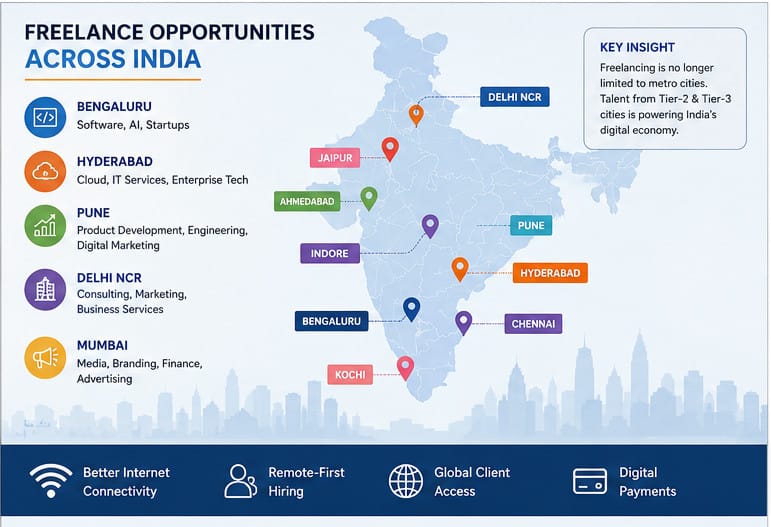
Freelancing Is Expanding Beyond Metro Cities
For years, cities like Bengaluru, Mumbai, Delhi NCR, Hyderabad, Pune, and Chennai dominated India’s freelance ecosystem because they offered better internet infrastructure, startup ecosystems, and access to technology companies.
That advantage still exists, but the market is becoming more distributed.
Reliable internet, cloud collaboration tools, digital payments, and remote-first hiring have reduced the importance of location for many digital services. Today, skilled professionals from Tier-2 and Tier-3 cities can compete for the same projects as freelancers based in larger metropolitan areas.
The shift is especially visible in software development, digital marketing, content creation, design, virtual assistance, video editing, and AI-related services.
What this means
Companies are evaluating freelancers based on their work, communication, and reliability rather than their city.
Why it matters
This creates opportunities for talented professionals who previously had fewer local employment options.
Freelancer takeaway
Your portfolio has become more important than your location.
A well-documented portfolio with measurable results often carries more weight than a city name on your profile.
Indian Cities Creating Freelance Opportunities
The following cities continue contributing significantly to India’s digital workforce.
| City | Major Strengths |
| Bengaluru | Software, AI, SaaS, Startups |
| Hyderabad | Cloud, IT Services, Enterprise Technology |
| Pune | Product Development, Engineering, Digital Marketing |
| Delhi NCR | Consulting, Marketing, Business Services |
| Mumbai | Media, Branding, Finance, Advertising |
| Chennai | Software Engineering, Manufacturing Technology |
| Ahmedabad | E-commerce, Business Services |
| Jaipur | Design, Content, Digital Marketing |
| Indore | Software Development, Remote IT Services |
| Kochi | Creative Services, Technology, Startups |
Observation
Opportunity is spreading faster than talent awareness.
Many businesses no longer search for “freelancers in Bengaluru.”
They search for specialists who can solve specific problems.
That subtle shift benefits professionals across India.
Freelancer Income Trends – Indian Freelancing Trends Report
One of the biggest misconceptions about freelancing is that income depends mainly on experience.
Experience matters. – It is not the only factor.
Two freelancers with similar technical skills can have dramatically different earnings because clients evaluate much more than technical ability.
The strongest income drivers often include:
- Specialization
- Portfolio quality
- Case studies
- Communication
- Industry expertise
- Client retention
- Personal branding
- Pricing strategy
Example
Imagine two SEO freelancers. – Freelancer A – Offers: – SEO Services – Freelancer B – Offers:
SEO Strategy for B2B SaaS Companies with Technical SEO Audits and Content Growth Plans
The second positioning immediately tells potential clients:
- who the service is for,
- what problem it solves, and
- what expertise to expect.
That clarity often leads to better-quality inquiries instead of simply attracting more inquiries.
What High-Earning Freelancers Often Do Differently
Many successful freelancers share similar habits.
They:
- Focus on one or two service categories.
- Build repeat business instead of constantly finding new clients.
- Create systems for proposals, onboarding, and reporting.
- Learn business communication alongside technical skills.
- Continuously update their expertise.
- Track measurable client results.
Notice that none of these habits depend on expensive software or a large team.
They are business practices rather than technical skills.
Biggest Challenges Indian Freelancers Face
Freelancing offers flexibility, but it also comes with challenges that traditional employment often doesn’t.
Understanding these challenges helps professionals prepare for long-term success.
Challenge 1: Finding Consistent Clients
Many freelancers experience periods where projects arrive in waves.
One month is fully booked. – The next month has very little work.
Why it happens
Client acquisition is often treated as a one-time activity instead of an ongoing process.
Practical solution
Maintain visibility by:
- Updating your portfolio regularly.
- Staying active on professional platforms.
- Asking satisfied clients for testimonials.
- Building long-term client relationships.
- Sharing useful industry insights.
Consistent marketing usually creates more predictable opportunities.
Challenge 2: Pricing Services
Pricing remains one of the most difficult decisions, especially for new freelancers.
Charging too little can attract low-quality projects.
Charging too much without demonstrating value can reduce inquiries.
Practical solution
Instead of pricing based only on hours worked, explain the business outcome your service delivers.
Clients often compare value before they compare rates.
Challenge 3: Standing Out in a Competitive Market
As freelancing grows, clients have more options.
Generic profiles rarely receive attention.
Practical solution
Avoid describing yourself only by your profession.
Instead of:
Graphic Designer
consider positioning around a specific problem or industry.
Examples include:
- Packaging Design for Food Brands
- UI Design for Healthcare Apps
- LinkedIn Content Strategy for Founders
- Shopify Store Optimization
Specific positioning helps clients quickly understand your expertise.
Challenge 4: Keeping Up With AI
AI tools evolve quickly.
Many freelancers worry that automation will replace their work.
In practice, businesses still need professionals who can:
- Verify accuracy.
- Understand business context.
- Make strategic decisions.
- Communicate with stakeholders.
- Produce original solutions.
Practical solution
Treat AI as part of your toolkit, not as your replacement.
Professionals who learn new tools while strengthening critical thinking are likely to remain competitive.
Challenge 5: Building Long-Term Client Relationships
Winning a project is only the beginning.
Long-term growth often depends on repeat business.
Practical solution
Deliver:
- Clear communication.
- Reliable deadlines.
- Transparent reporting.
- Proactive suggestions.
- Professional documentation.
Clients frequently return to freelancers who reduce management effort.
Future Outlook (2026–2030)
No one can predict the future with certainty.
However, current market trends point toward several developments that are likely to influence freelance work over the next few years.
AI Will Become a Standard Business Tool
Businesses are moving beyond experimenting with AI.
They are integrating AI into everyday workflows.
This increases demand for professionals who can:
- Implement AI solutions.
- Improve business processes.
- Review AI-generated output.
- Build AI-powered products.
- Train teams on AI adoption.
The emphasis is shifting from simply using AI tools to applying them effectively in real business environments.
Specialized Expertise Will Become More Valuable
General digital services are becoming increasingly competitive.
Businesses often prefer specialists because they require less training and can contribute more quickly.
Professionals with expertise in a particular industry or technology are likely to command stronger pricing than those offering broad, undifferentiated services.
Outcome-Based Hiring Will Continue Growing
Many companies are moving away from measuring hours worked.
Instead, they evaluate freelancers based on:
- Project quality.
- Business impact.
- Speed of execution.
- Reliability.
- Communication.
This benefits professionals who can demonstrate measurable results through case studies and client success stories.
Cross-Border Freelancing Will Expand
As remote collaboration becomes more common, international hiring is expected to remain an important source of opportunity for Indian professionals.
Freelancers who understand international client expectations, documentation standards, contracts, and communication practices may find additional growth opportunities.
Continuous Learning Will Become Essential
Technology changes quickly.
The skills that are valuable today may evolve over the next few years.
Successful freelancers are likely to view learning as an ongoing business investment rather than an occasional activity.
Improving technical skills, communication, project management, and industry knowledge can strengthen long-term career resilience.
Key Insights from Part 3
- Geography matters less than demonstrated expertise.
- Specialization often creates stronger pricing power than offering many unrelated services.
- Consistent client relationships are usually more valuable than constantly chasing new projects.
- AI increases the importance of human judgment, creativity, and strategic thinking.
- Freelancers who invest in learning, positioning, and professionalism are better prepared for long-term market changes.
Part 4: Hiring Best Practices, HunarBox, FAQs & Research Methodology
How Businesses Can Hire Better Freelancers
Finding a freelancer is relatively easy.
Finding the right freelancer requires a structured hiring process.
Many unsuccessful projects are caused by unclear expectations rather than a lack of technical skills.
Businesses that define project goals, communicate clearly, and evaluate expertise instead of hourly rates often achieve better outcomes.
Before Hiring, Define the Project Clearly
Create a project brief that answers:
- What problem needs to be solved?
- What are the expected deliverables?
- What does success look like?
- What is the timeline?
- Which skills are essential?
- What budget range is available?
Clear requirements reduce misunderstandings and help freelancers provide accurate proposals.
Evaluate Results Instead of Resumes
Years of experience don’t always reflect capability.
Instead, review:
- Portfolio quality
- Case studies
- Previous client feedback
- Industry knowledge
- Communication skills
- Problem-solving approach
Ask candidates to explain how they solved a previous client challenge rather than simply listing projects.
Look Beyond the Lowest Price
Choosing the lowest-priced proposal can increase project costs if work needs to be revised or redone.
Consider factors such as:
- Reliability
- Response time
- Technical expertise
- Quality standards
- Long-term collaboration potential
The most cost-effective freelancer is often the one who delivers consistent results with minimal supervision.
Build Long-Term Relationships
Many businesses repeatedly search for new freelancers.
An alternative approach is to maintain relationships with professionals who already understand your business.
Long-term collaboration often leads to:
- Faster project delivery
- Better communication
- Lower onboarding time
- Consistent quality
- Improved business outcomes
How HunarBox Supports India’s Freelance Ecosystem
As India’s freelance economy expands, professionals need more than just a place to list their services. They need a platform that helps them present their expertise, build credibility, and connect with businesses looking for relevant skills.
HunarBox is designed around this idea.
Instead of focusing only on profile creation, it aims to support meaningful connections between freelancers and businesses based on skills, experience, and project requirements.
Professionals can showcase their capabilities through structured profiles, portfolios, and service information, making it easier for potential clients to evaluate their expertise.
For businesses, discovering qualified talent becomes more efficient when profiles contain clear information about services, experience, and previous work.
Why this matters
As freelance marketplaces become more competitive, trust becomes a deciding factor.
A detailed professional profile with real work examples can help businesses make faster and more informed hiring decisions.
Recommendations for Freelancers
Based on the trends discussed throughout this report, the following priorities are likely to have the greatest long-term impact.
1. Build Expertise Before Expanding Services
It’s usually better to become highly skilled in one area than to offer many unrelated services with limited experience.
Depth often creates more value than breadth.
2. Maintain a Strong Portfolio
Your portfolio should demonstrate:
- Business problems solved
- Process followed
- Results achieved
- Technologies used
- Client outcomes
A portfolio that explains impact is often more persuasive than one that simply displays completed work.
3. Learn AI Responsibly
AI can improve efficiency, but clients continue to value originality, accuracy, and critical thinking. Use AI to support your work—not replace your expertise.
4. Invest in Communication
Clear communication influences client satisfaction just as much as technical ability. Regular updates, realistic timelines, and transparent expectations help build long-term trust.
5. Continue Learning
Technology changes quickly. Set aside time to improve technical skills, industry knowledge, and business understanding on a regular basis. Continuous learning helps freelancers remain competitive as markets evolve.
Frequently Asked Questions
Is freelancing growing in India?
Yes. Public industry reports and broader labour market trends indicate continued growth in remote work, digital services, and project-based hiring, creating more opportunities for independent professionals.
Which freelance skills are expected to remain in demand?
Software development, AI implementation, cybersecurity, cloud engineering, digital marketing, SEO, data analytics, UI/UX design, video production, and technical writing are expected to remain important across many industries.
Will AI replace freelancers?
AI is changing how many tasks are completed, but businesses still require professionals who can apply judgment, solve complex problems, communicate effectively, and produce reliable outcomes.
How can new freelancers find clients?
A strong portfolio, clear positioning, consistent networking, professional communication, and visible expertise usually contribute more to long-term success than sending a large number of generic proposals.
Should freelancers specialize?
For many professionals, specialization improves positioning because clients often search for expertise related to a specific problem or industry rather than general services.
Is freelancing a long-term career option?
For professionals who continue learning, adapt to technology, and build lasting client relationships, freelancing can provide sustainable career opportunities across multiple industries.
Research Methodology
This report is based on a review of publicly available information from government publications, labour market research, freelance platform insights, industry reports, and digital economy studies available at the time of writing.
Rather than reproducing third-party content, the report interprets broader market trends and combines them with original analysis to explain what those developments may mean for freelancers and businesses operating in India.
Market conditions continue to evolve. New technologies, economic changes, and hiring practices may influence future trends beyond the publication date of this report.
References
The analysis in this report draws upon publicly available information from sources such as:
- World Bank
- International Labour Organization (ILO)
- Ministry of Statistics and Programme Implementation (Government of India)
- NASSCOM
- Payoneer
- Upwork
- World Economic Forum
- LinkedIn Workforce Insights
- Grand View Research
- Relevant government and industry publications released before publication
Readers are encouraged to consult the latest editions of these reports, as employment trends and market data continue to evolve.
About This Report
Indian Freelancing Trends Report 2026 is an annual research initiative by HunarBox that analyzes the Indian freelance economy using publicly available data, industry reports, and original market interpretation.
The objective is to provide practical insights that help freelancers make informed career decisions and enable businesses to hire skilled professionals with greater confidence.
Future editions will continue tracking changes in hiring patterns, emerging skills, AI adoption, and the evolution of India’s digital workforce.