

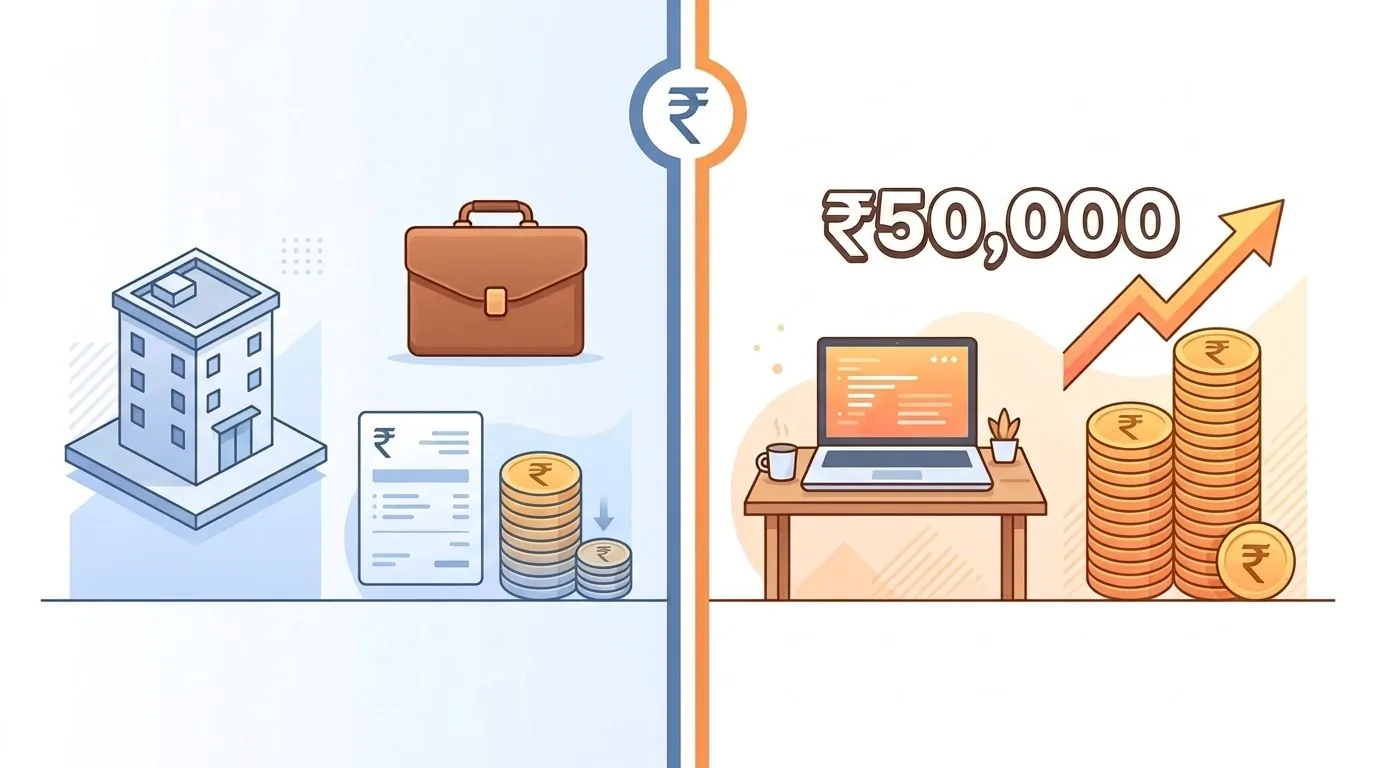
The difference between earning ₹50,000 as a Corporate Salary and earning ₹50,000 while Freenlancing
After all, ₹50,000 a month is ₹50,000 a month on paper. Whether originating from company payroll or a client bank transfer, the digit is indistinguishable. Things however, suddenly become far less simple as the month ends.
The ₹50,000 mentioned in your offer letter is highly unlikely to be what you actually get. And that ₹50,000 you bill a client is not even entirely your own – TDS and taxes nibbling at it, the people you need to pay daily. The net gain of income on both sides can to be very different after accounting — or not accounting if you have an EPF cut, commute costs, TDS from your clients and tax refunds.
Three hundred thousand won’t tell you anything if you’re not sure whether to keep doing what you’ve been doing or to move to full-time freelance. All that counts, is how much you made after the month. So, lets do the real math, rupee by rupee.
Table of Contents
Quick Answer
Freelancing usually leaves you with more spendable money than a corporate job at the same ₹50,000 gross income — roughly ₹45,000 to ₹47,000 in hand, compared to ₹41,000 to ₹42,000 from a job.
The reason isn’t obvious at first. Clients deduct 10% TDS upfront, so freelance income actually looks smaller when it hits your bank account. But Section 44ADA of the Income Tax Act lets freelancers earning up to ₹6 lakh a year pay zero income tax, which means that entire TDS amount comes back to you as a refund when you file your ITR. Add to that zero commuting costs, and freelancing pulls ahead.
The Numbers, Side by Side
| What Happens to ₹50,000 | Corporate Job | Freelance Income |
|---|---|---|
| Gross monthly amount | ₹50,000 | ₹50,000 |
| EPF + Professional Tax | ₹2,000 – ₹2,500 | ₹0 |
| TDS deducted upfront | ₹0 | ₹5,000 (10% under Sec 194J) |
| Actual income tax owed | Minimal | ₹0 (refunded via Sec 44ADA) |
| Commute, fuel, canteen | ₹4,000 – ₹6,000 | ₹0 |
| Internet, tools, electricity | ₹0 | ₹2,000 – ₹3,000 |
| Health insurance | Usually covered by employer | ₹800/month (self-paid) |
| What you actually keep | ~₹41,000 – ₹42,000 | ~₹45,000 – ₹47,000 |
Tax rules and slabs can change with each Union Budget. The figures above reflect the rules current as of this writing — always check incometax.gov.in or a tax professional before filing.
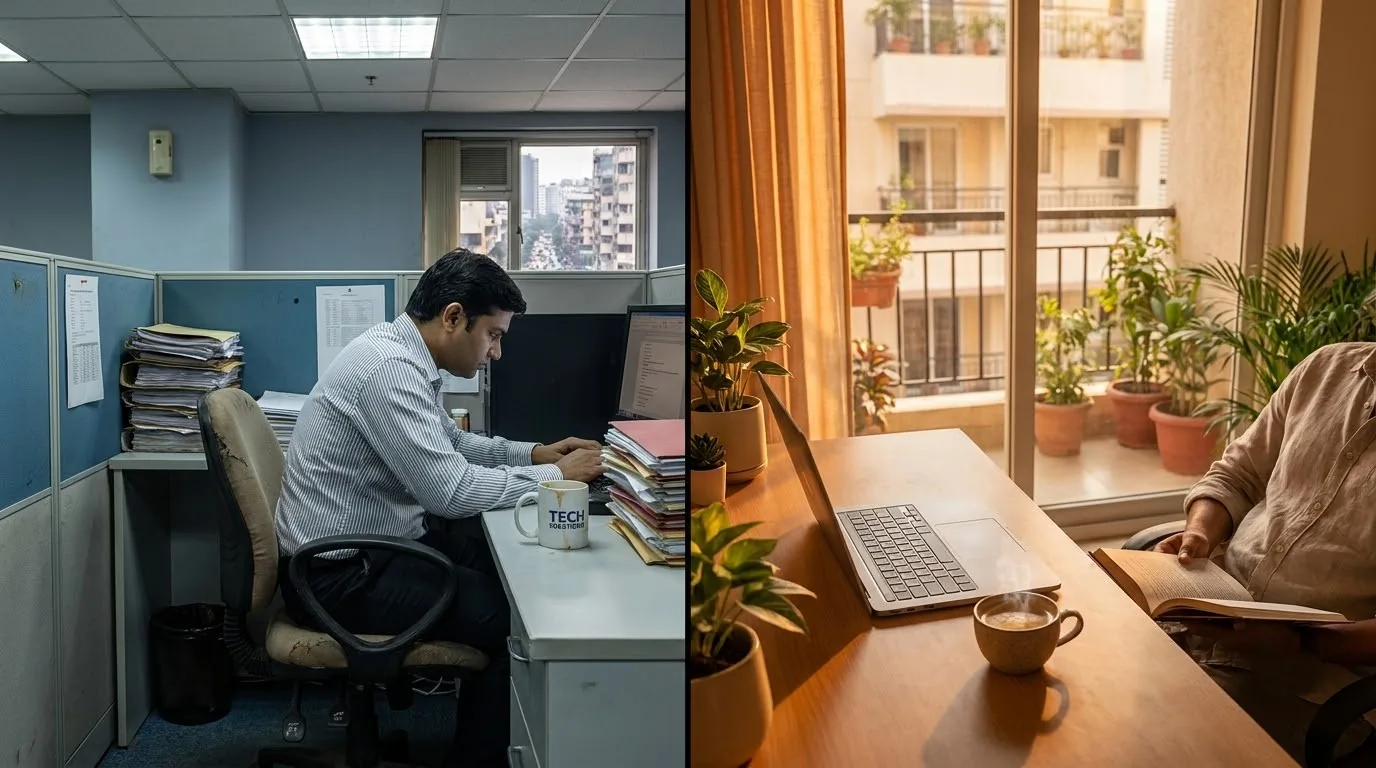
Where Does a Corporate ₹50,000 Salary Actually Go?
An offer letter that promises ₹6 lakh a year sounds like ₹50,000 landing in your account every month. It doesn’t work that way, and here’s why.
The automatic deductions. Before the money even reaches your bank, two things get cut. Employee Provident Fund takes around 12% of your basic pay — usually ₹1,800 to ₹2,400. This isn’t lost money; it’s sitting in your retirement account. But you can’t spend it this month, so as far as your everyday budget goes, it’s gone. Then there’s Professional Tax, a flat ₹200 charged by most state governments.
After these two cuts, you’re looking at roughly ₹47,400 in your account.
The costs nobody puts in a spreadsheet. This is where a job quietly eats into your salary. Getting to the office and back — by bike, car, auto, or metro — for 22 days a month adds up to ₹2,500 to ₹4,000. Then there’s the daily chai, snacks, and the occasional lunch with colleagues. Even at ₹70 a day, that’s close to ₹1,500 a month. And most offices expect you to look presentable, so formal clothes and their upkeep cost another ₹800 to ₹1,200.
Put it all together — deductions, travel, food, and clothing — and a ₹50,000 salary settles at around ₹42,000 in real spending power. You’ve also spent 9-10 hours at work plus 1-2 hours commuting to earn it.
Where Does ₹50,000 in Freelance Income Actually Go?
Freelancing works on a completely different logic. There’s no EPF, no HR, and no company paying for your desk. But the tax system treats you very differently too — and mostly in your favour.
The TDS cut that isn’t actually a loss. When an Indian client pays you ₹50,000, they’re required to deduct 10% TDS under Section 194J before the payment reaches you. So ₹45,000 lands in your account, and ₹5,000 goes straight to the Income Tax Department against your PAN. It shows up in your Form 26AS. It feels like a loss — but it isn’t, because of what comes next.
Section 44ADA changes everything. This is a simplified tax scheme built specifically for individual professionals like freelancers, consultants, and designers. Under this rule, the government assumes that 50% of your income goes into running your business, so only half your earnings are counted as taxable income. On a ₹6 lakh annual income, that means only ₹3 lakh is taxable — and at current tax slabs, income up to ₹3 lakh attracts zero tax.
So if your actual tax liability is zero, the ₹60,000 in TDS that clients deducted through the year (₹5,000 × 12 months) comes back to you in full when you file ITR-4. That works out to an effective ₹5,000 a month returning to your pocket, just later than you’d like.
The costs you do have to cover yourself. Freelancers don’t have HR handling their infrastructure, so a few expenses fall on you directly — reliable Wi-Fi and power backup (around ₹1,500), software subscriptions and tools (₹1,000), and health insurance since there’s no employer group cover (₹800). That’s roughly ₹3,300 a month in overhead.
Add it up: ₹45,000 received, minus ₹3,300 in costs, plus the ₹5,000 monthly share of your tax refund, and you land at roughly ₹46,700 in real, usable money — without spending a single rupee on commuting.
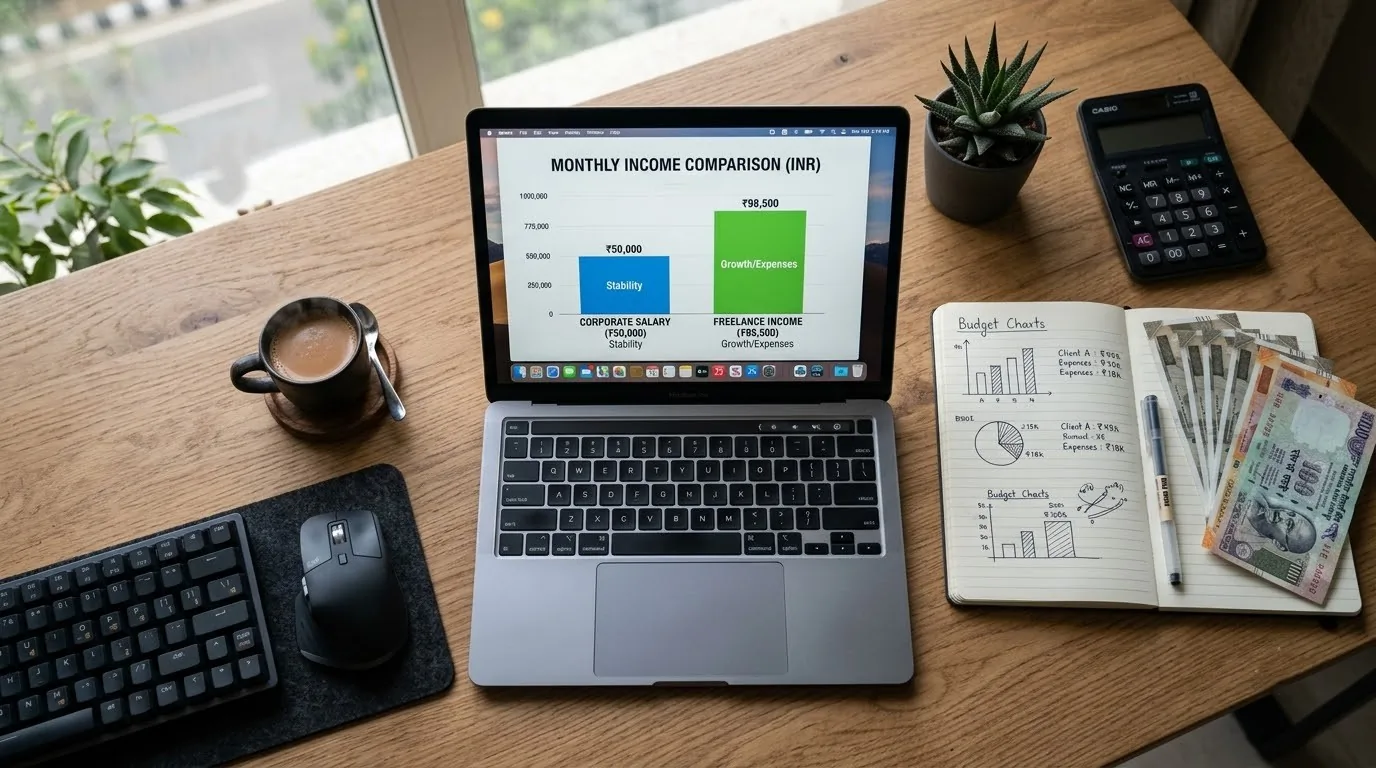
So, who actually wins?
If steady predictability, company-paid insurance, and clear working hours matter most to you, a job still offers something freelancing can’t easily replace — a safety net, even if it costs you more in daily expenses.
But if your priority is keeping more of what you earn, cutting out commute stress, and having no real ceiling on your income, the math clearly favours freelancing. A ₹50,000 freelance income, managed well, doesn’t just leave more money in your account today — it also builds toward something that can keep growing.
FAQ – Corporate Job vs Freelancing
Is freelancing income really tax-free up to ₹6 lakh a year?
Yes, for most individual freelancers earning up to ₹6 lakh annually, the taxable income after the 50% deduction under Section 44ADA falls below ₹3 lakh, which attracts zero tax under current slabs. This applies to professionals like designers, writers, developers, and consultants — not to freelance trading or business income, which is taxed differently.
Is it safe to quit a job and freelance full-time?
It depends on how stable your client base already is. A common approach is to keep the job while freelancing part-time, and make the switch once freelance income consistently reaches 70-80% of your salary for a few months in a row. Jumping in without any existing clients is riskier.
Does freelance income get counted for home loans or credit cards?
Yes, but banks usually ask for your last 2-3 years of ITR filings and bank statements to verify income stability, since freelance income isn’t as predictable as a salary slip. This is another reason regular ITR filing matters even when your tax liability is zero.
What about you — are you weighing a similar decision right now? Drop your situation in the comments, we’d love to hear it.
This article is for general informational purposes only and does not constitute professional tax or financial advice. Tax rules and slabs can change with each Union Budget — please consult a chartered accountant for guidance specific to your situation.