

Introduction: The Freelance Truth
Are you one of those people who have just stepped into the world of freelancing? You probably have big dreams in your eyes—the dream of being your own boss, the freedom to work from any corner of the world, and the desire to earn in dollars.
All of this can be true. Freelancing is indeed a beautiful journey.
But, at the start of this journey, there is a dark truth hidden that newcomers are often afraid to discuss, or simply unaware of. That truth is—Freelance Scams.
Picture this: You receive an email. Someone is offering you $500 (approx. ₹40,000) for a very simple task. You get excited. You think, “This is it, I’ve hit the jackpot!” You instantly say yes.
A few hours later, that ‘client’ tells you, “Before we start, you need to deposit a small security fee of just $20 (₹1,600) for our company ID card, which is refundable later.”
You think, “What is $20 compared to the $500 I’m about to earn?” So, you send the money.
And then? Silence.
The client disappears. Your number gets blocked. Your money is gone, and even worse—your confidence is shattered.
This story is not fiction. This is happening to thousands of new freelancers every single day.
If you want to carve out a space for yourself in the freelancing world, your biggest skill isn’t ‘coding’, ‘writing’, or ‘designing’. Your most critical skill is—knowing how to identify genuine freelance clients and avoid scams.
This guide is not just an article. It is your shield. In this post, we will walk through the nuances that will make you a street-smart freelancer. We will cover everything a mentor would tell you over a cup of coffee.
How to identify genuine freelance clients and avoid scams
Let’s dive in and turn you into a survivor.
Part 1: Spotting the Scammers –
The Red Flags
Scammers are cunning, but they always make mistakes. To catch them, you just need to keep your eyes and ears open. If you see any of the following signs, proceed with extreme caution.
- The Biggest Red Flag: They Ask for Money
Let’s make this the Golden Rule of freelancing: Money always flows FROM the client TO the freelancer. Never the other way around.
If anyone asks you for a single rupee in exchange for giving you work, it is a 1000% scam. It doesn’t matter what fancy name they give it:
• “Security Deposit”
• “Registration Fee”
• “ID Card Charge”
• “Training Material Cost”
• “Software Installation Fee”
Reality Check: A genuine client needs work done. They will pay you for your services; they won’t ask you to pay them. If a massive company like Google or Amazon hires you, do they say, “Deposit $100 before joining”? No, right? So why would you pay a stranger on the internet?
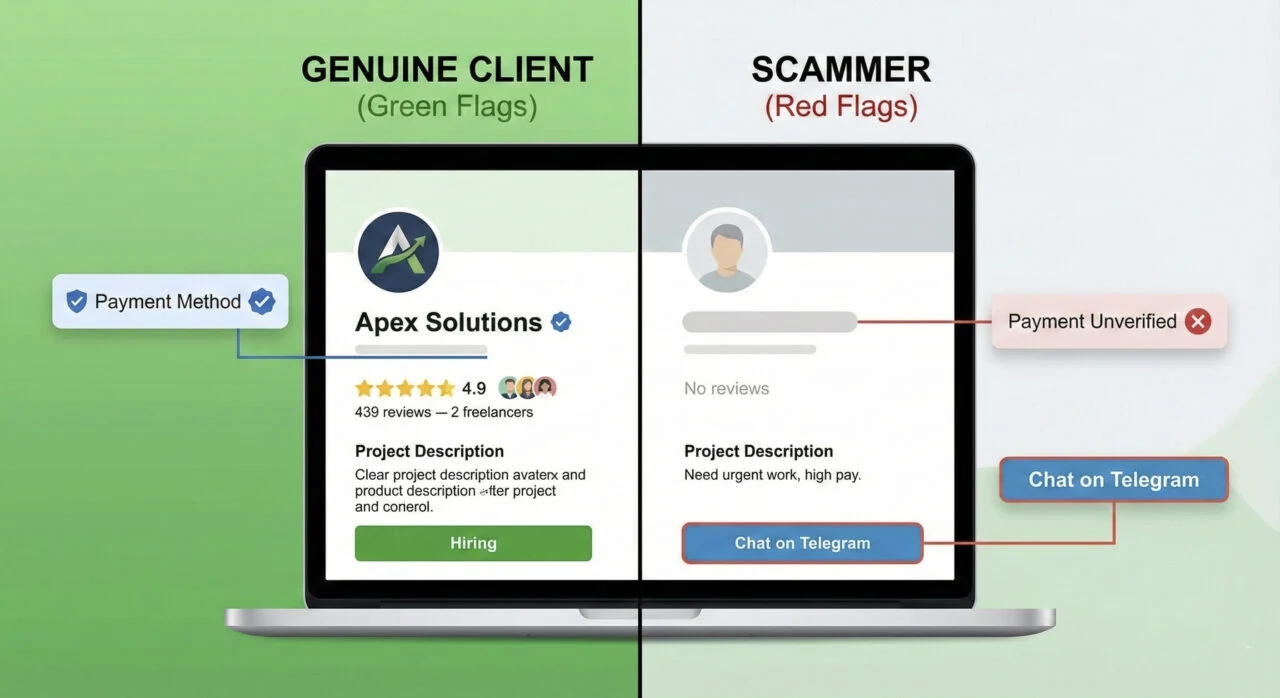
Advice: The moment money is demanded, block that person immediately and report them to the platform. - The “Telegram/WhatsApp” Trap (The Platform Shift)
You are on a platform like Upwork, Freelancer, or Hunarbox. You get a message:
“Hey, I liked your profile. We have an urgent project. For a quick discussion, please message our HR manager on Telegram: @FakeHR_123.”
This might sound professional, but it is a massive trap.
Why do they do this?
Freelance platforms have security systems that detect scam keywords. Scammers want to pull you out of that safety net immediately and take you to Telegram or WhatsApp, where there is no monitoring. Once you are there, they can manipulate you easily without the platform warning you.
Advice: Always tell the client, “For security reasons, I prefer to keep all communication on this platform until the contract is finalized.” A genuine client will respect this. A fake client will make excuses or disappear. - Too Good To Be True? Then It Is.
Have you ever seen a job posting like this?
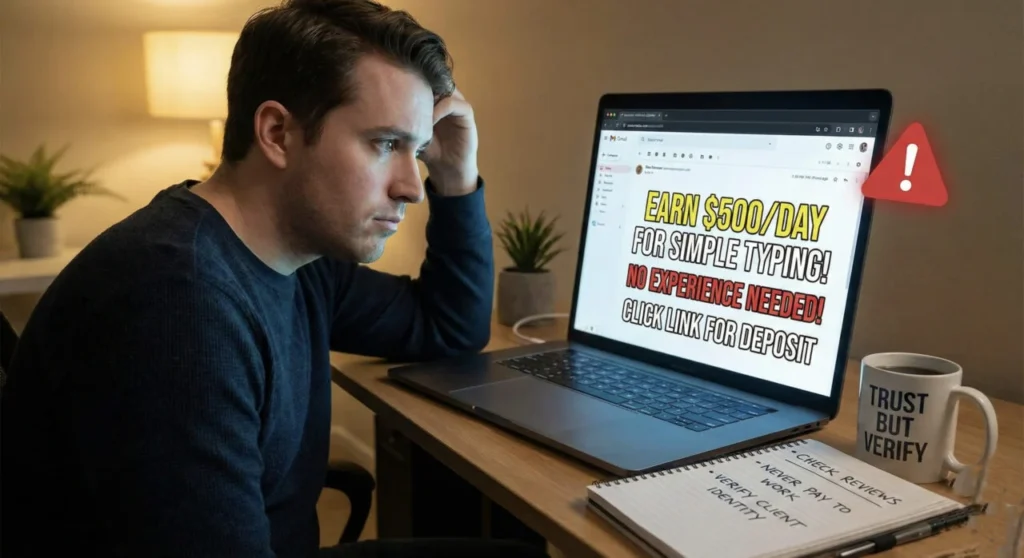
“Retype 100 pages from PDF to Word and earn $800. No experience needed. Instant payment.”
Ask yourself honestly—is there any job in the world where you get paid that much just for simple typing?
If this were true, why would anyone become a doctor or engineer? Everyone would just be typing PDFs.
Scammers prey on the desperation of beginners. They know you need money, so they dangle a huge amount as bait.
Remember: If an offer looks far removed from reality, believe me, it is not reality. It is a trap. - The Demand for Free Work (The “Free Sample” Scam)
Some clients say, “We need to see if you are good enough. Write this 5-page article as a sample first. If we like it, we will hire you.”
This is not a “test”; this is a way to get work done for free. They get 10 different freelancers to write one part each, and their whole project gets finished without spending a dime.
Advice: Never do a full project as a “free sample.” If they want to see your work, show them your portfolio. If they insist on a test, tell them you are open to a small, paid test.
Part 2: Spotting the Real Deal – The Green Flags
We’ve talked about the dangers. Now let’s talk about what a genuine, legitimate client looks like. When you see these signs, you can breathe a little easier.
- Verified Payment Method
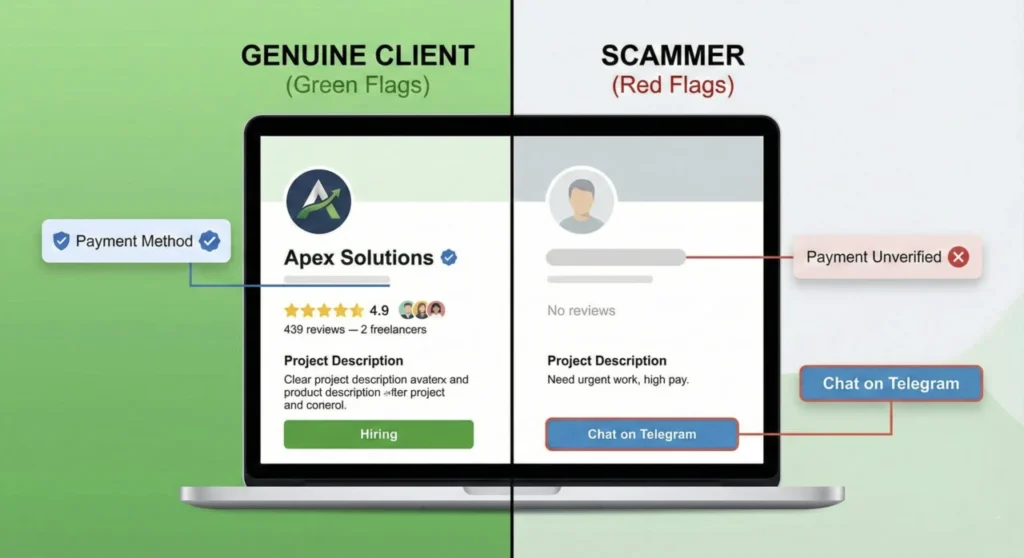
On most reputable freelance platforms, client profiles have a badge that says “Payment Method Verified.” This means the client has linked a valid credit card or bank account to the platform and has the ability to pay.
If a client’s payment method is unverified, and they are offering a massive budget, be skeptical. - Clear Project Description
A real client knows what they want. Their job posting will look something like this:
“We need a 5-page WordPress website designed with ‘About Us’, ‘Services’, and ‘Contact’ pages. We have the content ready; we just need the design and development. Budget: $200 – $300.”
In contrast, a scammer will write:
“Need urgent work done. Good pay. Contact me.”
The difference is clear. A real client gives details; a fake client keeps things vague. - Professional Communication
Genuine clients communicate professionally. Their email addresses are often domain-based (e.g., name@company.com) rather than a random Gmail address (e.g., coolboy123@gmail.com). While many small business owners do use Gmail, their tone will always be respectful and focused on the work, not on asking for personal favors or data.
Part 3: Platform-Specific Safety Tips
Every freelance platform has a different “vibe,” and scammers adapt their methods accordingly. Here is how to stay safe on the big ones.
A. Safety on Upwork
Upwork is the giant of the industry, but risks exist here too.
• Feedback Extortion: Some bad clients might blackmail you after the work is done. “If you don’t do this extra work for free, I will give you a 1-star rating.”
o Solution: Upwork policy strictly forbids this. Do not get scared. Take screenshots of the chat and report it to Upwork Support immediately.
• Payment Outside Escrow: The client says, “Upwork charges too much fee, let me pay you directly via PayPal or Bank Transfer.”
o Solution: Never agree to this! The ‘Escrow’ system protects your money. If you deal outside the platform and the client runs away, Upwork cannot help you.
B. Safety on Fiverr
Fiverr is known for quick gigs, so scams here are fast-paced.
• Contact Before Order: Often, a scammer will message you asking to talk on Skype or Zoom before placing an order. Fiverr does not allow this. Keep everything within the Fiverr message box.
• The Review Exchange: Someone might message you: “Buy my gig and I will buy yours. We will give each other 5 stars.” This is review manipulation. It can get your account permanently banned.
C. Safety on Hunarbox & Indian Platforms
Freelancing is booming in India, and platforms like Hunarbox are rising. However, in the Indian context, scams get a bit “Desi.”
• UPI/Paytm Registration Fee: This is the most common scam in India. “Sir, your job is confirmed, just send ₹499 registration charge to this UPI number.”
o Remember: No genuine Indian company or client will ask for money via Google Pay or Paytm just to give you a job. This is 100% fraud.
• Data Theft: Some people will send you a ‘Job Application Form’ link asking for your Aadhar Card, PAN Card, and Bank Details. Never share sensitive personal data without fully verifying the company.
Part 4: The Vetting Process (How to Investigate)
Before you say “Yes” to any project, play detective. A little research can save you from a huge loss.
Step 1: Google is Your Best Friend
If the client provided a company name, search for it.
• Search: “Company Name” + scam or “Company Name” + reviews.
• Check if they have a website. Does it look professional? Is there a real address and phone number?
Step 2: Check LinkedIn
If you are talking to a specific person, find them on LinkedIn.
• Does their profile look real?
• Do they have connections?
• Does the company they claim to work for actually exist on their profile?
If a profile was created yesterday and has no photo, that’s a warning bell.
Step 3: Insist on a Contract
This is the mark of a pro. For any decent-sized project, always ask for a contract. It should outline:
• Scope of Work (What you will do)
• Payment Terms (How much and when)
• Deadlines
Genuine clients love contracts because it protects them too. Scammers hate paper trails and will likely run away.
Part 5: Your Gut Feeling – The Ultimate Weapon
Sometimes, everything looks fine on paper. The profile is okay, the chat is okay. But… you have a weird feeling in your stomach. Something feels “off.”
This is your intuition.
In freelancing, learn to trust this sixth sense. If you feel uncomfortable while talking to a client, if you feel they are being too pushy, or if they are being overly sweet without reason—stop.
Even if you don’t have solid proof, if your mind says “no,” then it’s better to walk away. It is far better to spend that time learning a new skill than working for a bad client.
Frequently Asked Questions (FAQs)
Q1: I have already been scammed and paid money. What should I do now?
Ans: I am sorry to hear that. First, stop blaming yourself. It happens to the smartest people. Take action immediately:
- If you paid via Credit Card/Bank, call your bank and report the transaction as fraud. They might file a ‘chargeback’.
- If you paid via UPI, file a complaint on the National Cyber Crime Portal (cybercrime.gov.in).
- Report the user on the platform where you met them so they can’t hurt others.
Q2: Is it true that new freelancers don’t get work easily, so we have to take risks?
Ans: No! Take risks with work (like taking on a challenging project), but never take risks with your safety. Yes, getting the first client takes time. But getting desperate and falling for a scam will end your career before it starts. Have patience, build your portfolio, and the right work will come.
Q3: Is every client on Telegram fake?
Ans: Not 100%, but in 99% of cases, if they ask you to move to Telegram in the first message, it is fake. Some legitimate teams use Telegram, but they will usually hire you on the official platform first and then move to a chat app for daily updates.
Conclusion: Stay Safe, Be Successful
Freelancing is like a jungle. There are plenty of opportunities, but there are predators hiding in the bushes.
This guide wasn’t meant to scare you, but to prepare you. When you know how to identify genuine freelance clients and avoid scams, you can work fearlessly.
Remember, your hard work and your skills are valuable. Do not waste them on someone who doesn’t respect them.
Keep your eyes open, stick to your principles, and never pay to get a job. There are amazing, genuine clients out there looking for talent just like yours.
Stay safe, and happy freelancing!
[…] [How to identify genuine freelance clients and avoid scams] […]